La Doble Captura del Islam: Opresión Dictatorial y Vaciamiento "Light"
La transformación sectaria del Islam contemporáneo
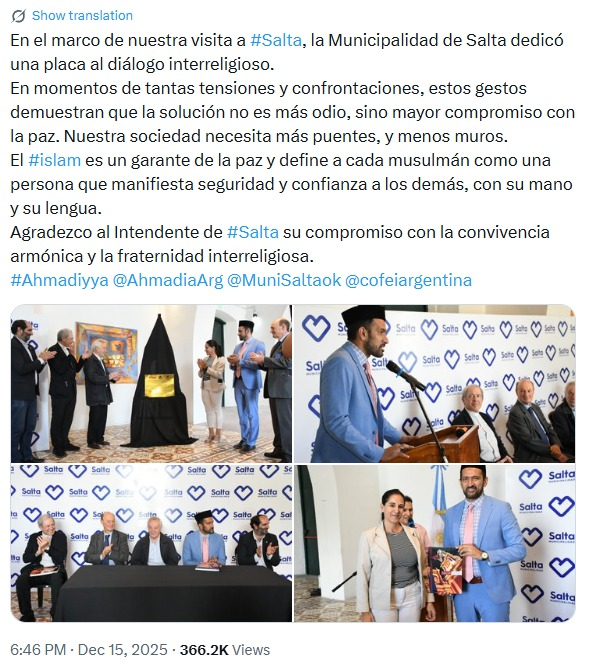
El 15 de diciembre de 2025, la Municipalidad de Salta colocó una placa dedicada al diálogo interreligioso en un acto que contó con la participación de representantes de la Comunidad Musulmana Ahmadía. Este gesto institucional, promovido por el intendente municipal, buscaba destacar valores de convivencia armónica, fraternidad y construcción de paz en un contexto global de tensiones. El mensaje central fue claro: en lugar de muros, la sociedad necesita más puentes.
¿Quiénes son los musulmanes ahmadías?
La Comunidad Ahmadía es un movimiento religioso islámico fundado en 1889 en la India colonial por Mirza Ghulam Ahmad, quien se presentó como una figura renovadora espiritual. Sus creencias centrales representan una reinterpretación distintiva del Islam. Ghulam Ahmad se declaró el Mesías y Mahdi prometido, no como un profeta independiente, sino como un "profeta subordinado" a Mahoma, venido a renovar el Islam en tiempos modernos.
Creen que Jesús sobrevivió a la crucifixión, viajó a Cachemira y murió allí de muerte natural, por lo que no habrá un regreso físico de Jesús. Consideran que Ghulam Ahmad cumplió esa promesa de manera espiritual. Rechazan toda interpretación violenta del yihad, definiéndolo únicamente como una lucha espiritual, intelectual y pacífica. Enfatizan la obediencia absoluta a las leyes del país donde residen, promoviendo una separación clara entre religión y Estado. Su lema es "Amor para todos, odio para nadie".
Tras la muerte de su fundador, establecieron un sistema de califato. El califa actual es Mirza Masroor Ahmad, quinto sucesor en el cargo desde 2003. Su sede central está en Londres, Reino Unido, tras exiliarse de Pakistán, y tienen presencia organizada en más de 200 países. Son muy activos en proselitismo, traducción del Corán, obras humanitarias y educación, y operan su propio canal de televisión.
Un diálogo estratégico y sus significados
Para la Comunidad Ahmadía, este reconocimiento oficial por parte de una autoridad municipal representa una validación importante de su existencia y mensaje en un contexto global complejo. El acto les permite presentarse ante la sociedad salteña como los representantes de un Islam pacífico y dialogante, diferenciándose estratégicamente de otras expresiones islámicas.
Para la Municipalidad de Salta, el gesto se inscribe en un discurso de inclusión, diversidad y paz social, valores con amplia aceptación en el espacio público argentino. Sin embargo, al interactuar principalmente con una comunidad que predica una versión absolutamente pacifista del Islam, la municipalidad podría estar simplificando el panorama islámico real, eludiendo la complejidad de otras corrientes islámicas presentes en Argentina, cuyas posturas sobre la relación entre religión, ley y sociedad son más matizadas y potencialmente más difíciles de encajar en el marco secular.
Existe una paradoja significativa en este acercamiento: mientras la Ahmadía es rechazada por la gran mayoría musulmana global por sus diferencias doctrinales, encuentra en Occidente y en autoridades locales como la de Salta una recepción favorable precisamente por esas mismas diferencias, particularmente su pacifismo extremo y lealtad secular. Así, se establece un "diálogo" con una comunidad que, dentro de su propia tradición religiosa, ocupa una posición marginal.
La Visita de la Comunidad Ahmadía a Salta: Entre el Reconocimiento y la Doble Opresión
La reciente colocación de una placa en honor al diálogo interreligioso en la Municipalidad de Salta, en un acto protagonizado por la Comunidad Musulmana Ahmadía, se presenta ante la sociedad como un gesto inequívoco de paz y construcción de puentes. Bajo la superficie de este símbolo, sin embargo, se esconde una encrucijada profunda y desafiante para el musulmán que aspira a vivir su fe con integridad en Argentina. Este evento no es una mera celebración de la diversidad, sino el punto donde convergen y chocan dos fuerzas opresoras que definen su experiencia religiosa.
La primera de estas fuerzas es la opresión que surge de la imposición de un Islam político y foráneo. Contrario al relato del inmigrante que se adapta, ciertos liderazgos comunitarios importan y perpetúan una versión del Islam no moldeada por la espiritualidad pura, sino por contextos políticos ajenos a la democracia liberal. Esta es una fe filtrada a través de dictaduras militares, monarquías, regímenes o el trauma de conflictos tribales. Lo que se transmite, entonces, no es solo una religión, sino un paquete cultural-político completo: sistemas rígidos de comportamiento, mecanismos de control social y una exigencia de lealtad comunitaria cerrada. Para el musulmán, ya sea argentino o inmigrante que busca integrarse genuinamente, esta versión se vuelve una camisa de fuerza. Transforma la práctica islámica, que debería ser un camino espiritual personal, en la ejecución obligada de un protocolo ajeno, que lo aísla de la sociedad broader y choca frontalmente con los valores individualistas y seculares del país.
Frente a esta primera presión, emerge una segunda fuerza opresora, aparentemente opuesta pero igualmente corrosiva: el vaciamiento por relativismo. Es la respuesta institucional y social que, en un bienintencionado esfuerzo por hacer al Islam "aceptable" y "pacífico" para el discurso políticamente correcto, opta por diluir su contenido sustancial. En este proceso, pilares fundamentales son suavizados hasta perder su significado. La Sharia, la Ley Islámica que para un creyente representa la voluntad tangible y social del Legislador Divino (Al-Hakam), es reducida a una simple "guía moral personal". El Corán, libro de mandatos y revelación clara, es reinterpretado como un compendio de metáforas amables. El musulmán queda así reducido a la categoría de "ciudadano con un accesorio cultural", a quien se le niega la posibilidad de que su fe tenga implicaciones públicas o exigencias reales. El resultado es un "islam light", un cascarón vacío que, al privar al creyente de la seriedad de su Ley, la realidad de su Revelación y la integridad de su práctica, traiciona la esencia misma de su creencia desde dentro. Le ofrece integración a cambio de la abdicación de su identidad teológica.
El musulmán devoto queda así atrapado en una trampa de doble filo. Por un lado, es oprimido por concepciones políticas extrañas, heredadas de contextos dictatoriales o de conflicto, que secuestran su religión para fines de control comunitario. Por el otro, es oprimido por un relativismo benevolente que, buscando protegerlo o integrarlo, le roba sistemáticamente el núcleo de su fe. El acto en Salta con la Comunidad Ahmadía es paradigmático de este segundo polo de opresión. La Ahmadía, a pesar de su estatus de comunidad perseguida en gran parte del mundo musulmán, se presenta aquí como la encarnación funcional de ese Islam pre-vaciado. Su doctrina—con su yihad exclusivamente pacífico, su lealtad absoluta al estado secular y su profetología que rompe con la ortodoxia mayoritaria—ofrece voluntariamente la versión descafeinada que el entorno secular anhela. Por ello, no representa una solución a la dicotomía, sino la manifestación misma y la consolidación del problema del vaciamiento.
La verdadera integración y un diálogo interreligioso auténtico y respetuoso no pueden construirse sobre ninguno de estos dos extremos fallidos. No pueden erigirse ni sobre la imposición de una política dictatorial foránea, ni sobre la fabricación de un islam ficticio y diluido. Debe partir, necesariamente, del reconocimiento honesto de que el Islam es un sistema de creencias serio y completo, con sus propias leyes, aspiraciones comunitarias y desafíos intelectuales. Un diálogo fructífero con la democracia secular requiere abordar estas complejidades con valentía intelectual, evitando los atajos de los símbolos fáciles y los eslóganes vacíos. Solo un respeto mutuo que no tema a la diferencia sustancial, y que rechace tanto el autoritarismo importado como el relativismo engañoso, puede tender puentes que sean verdaderamente sólidos y dignos para todos.
La negación sistemática como mecanismo sectario
Un fenómeno preocupante se manifiesta en ciertas expresiones contemporáneas del Islam: su transformación gradual en estructuras de carácter sectario. Este proceso no se produce mediante la afirmación de nuevos dogmas, sino precisamente mediante negaciones sistemáticas de elementos constitutivos de la tradición islámica clásica. La negación de la capacidad transformadora del Islam sobre la realidad social, el rechazo de la Sharia como sistema jurídico integral, la renuncia a toda acción política significativa y, en sus expresiones más extremas, la negación misma del concepto de yihad como lucha multidimensional, constituyen los pilares de esta mutación.
Estas negaciones no son meras omisiones, sino afirmaciones inversas que van conformando principios y creencias en estructuraciones particulares y heteróclitas. Lo que emerge no es simplemente una versión "moderada" o "adaptada" del Islam, sino una nueva unidad identitaria con dinámicas internas que replican patrones sectarios. Esta nueva formación mantiene ciertos símbolos y terminología islámica, pero vaciados de su contenido histórico-teológico original y rellenados con significados compatibles con el paradigma secular-liberal.
La ley oral y el arbitrio autoritario
Lo distintivo de este Islam sectario no es que mantenga una estructura conectada con el orden civil clásico islámico (el sistema califal o de jurisprudencia tradicional), ni que codifique sus principios en una ley escrita sistemática. Por el contrario, permanece como ley oral, siempre susceptible de modificación según el arbitrio de la autoridad inmediata. Esta característica responde a una razón fundamental: en este sistema se conecta con la mentalidad tiránica importada a nuestro país mediante hábitos culturales arraigados en experiencias políticas autoritarias de origen.
Estos hábitos, provenientes de contextos dictatoriales o teocráticos, se conjugan con los intereses y deseos personales del líder o grupo a cargo, generando estructuras de poder discrecionales y opacas. La autoridad no se deriva de un sistema de jurisprudencia objetiva (fiqh) con siglos de desarrollo, ni de principios teológicos verificables, sino del carisma, la conveniencia o la imposición del líder. Este fenómeno explica por qué comunidades supuestamente religiosas replican dinámicas de culto a la personalidad, obediencia incondicional y pensamiento grupal típicas de sectas.
El refugio identitario frente a la sociedad exterior
Este sistema nace y se consolida como refugio seguro frente a la confrontación con la sociedad externa. Ante el desafío que representa la cultura secular argentina con sus valores universales (aunque, desde la perspectiva islámica clásica, considerados "equivocados y creados" por el ser humano), estas comunidades construyen fortalezas identitarias. La conexión con esa sociedad externa -que representa constitucionalmente valores universales como la libertad individual, la igualdad ante la ley y los derechos humanos- se establece únicamente mediante valores puente que representan lo que podríamos llamar "universalidad pagana" dentro del Islam.
Estos valores puente -la paz como ausencia de conflicto, la tolerancia como indiferencia, el diálogo como fin en sí mismo- funcionan como garantía ante el mundo secular, pero se pagan a un precio altísimo: la pérdida de la universalidad islámica auténtica. Esta universalidad, que en la tradición clásica se entendía como la pretensión de que los principios islámicos ofrecían respuestas válidas para toda la humanidad en todos los tiempos, queda negada por principio en este Islam light. Se acepta así un reduccionismo culturalista: el Islam sería válido solo para musulmanes, en su vida privada, sin pretensión alguna de ofrecer soluciones para la organización social, económica o política de la humanidad.
La dualidad estructural del Islam sectario
En esta estructura de Islam sectario observamos dos formas distintas pero interconectadas. Por un lado, la identificación y consolidación grupal que alcanza casi el sentido de "pueblo elegido", con fronteras claras entre los "verdaderos creyentes" (dentro del grupo) y los demás (incluidos otros musulmanes). Por otro, una estructura doctrinal identificada con el humanismo moderno que sirve como carta de presentación ante la sociedad mayoritaria.
Esta dualidad crea una tensión permanente entre el particularismo grupal (nosotros, los puros, los elegidos) y el universalismo declarativo (nuestros valores son los de toda la humanidad). Grupos como la Ahmadía han logrado convertir esta contradicción en una institución viable, presentando su particular interpretación como la versión "verdadera" y "universal" del Islam. Sin embargo, es crucial aclarar que este fenómeno no es exclusivo de la Ahmadía, sino que afecta a prácticamente todas las instituciones islámicas en la sociedad actual.
La sectarización como estrategia de supervivencia
Lo que observamos es un proceso de sectarización estratégica del Islam en contextos minoritarios. Ante la imposibilidad de implementar el proyecto civilizatorio islámico clásico en sociedades secularizadas, y ante el rechazo a someterse a las estructuras autoritarias importadas, muchas comunidades optan por esta tercera vía: convertirse en sectas identitarias que negocian su supervivencia mediante la adopción de valores seculares como moneda de cambio.
El resultado es un Islam desuniversalizado, desjuridificado y despolitizado, pero hiperidentitario en el nivel grupal. Un Islam que ha abandonado su pretensión de transformar el mundo para contentarse con ofrecer un refugio psicológico y comunitario a sus miembros. En este proceso, lo que se pierde es justamente lo que hizo históricamente del Islam una civilización: su capacidad para generar sistemas jurídicos completos, estructuras sociales coherentes y visiones del mundo comprehensivas.
La placa en la Municipalidad de Salta simboliza perfectamente este fenómeno: el reconocimiento institucional de un Islam que ha aceptado las reglas del juego secular, que ha intercambiado su universalismo transformador por un lugar en el paisaje multicultural, y que ha convertido lo que alguna vez fue una civilización en una opción identitaria más en el mercado de las creencias.
Somalilandia e Israel: Un paradigma de independencia frente a sistemas opresivos
La independencia de Somalilandia y su reconocimiento formal reciente por parte de Israel en diciembre de 2025 no constituye únicamente un evento geopolítico, sino que emerge como un paradigma simbólico poderoso de la búsqueda de liberación frente a sistemas políticos y religiosos percibidos como opresivos. Este acontecimiento ofrece una lente privilegiada para comprender las dinámicas de resistencia, pragmatismo y redefinición identitaria que hemos analizado en el contexto de comunidades como la Ahmadía y la transformación sectaria del Islam.
Somalilandia declaró su independencia de Somalia en 1991, tras décadas de marginalización y una brutal campaña de represión por parte del régimen de Siad Barre, que incluyó bombardeos a su capital, Hargeisa. Su camino posterior ha sido el de construir, de facto, un Estado funcional y una democracia estable en una región convulsa. Este logro representa, en esencia, la ruptura con un sistema central fallido y violento. El reconocimiento por parte de Israel —un Estado que, a su vez, nació de una lucha por la autodeterminación y que ha vivido en permanente conflicto existencial con sus vecinos— selló esta independencia con un acto de solidaridad estratégica entre entidades políticas que se perciben a sí mismas como islas de orden y democracia en medio de un mar de inestabilidad.
Las imágenes que circularon tras el anuncio fueron elocuentes y profundamente significativas: mujeres musulmanas portaban hiyabs confeccionados con los colores exactos de la bandera de Israel. En otras, hombres realizaban sus oraciones sobre banderas israelíes. Estos actos no deben interpretarse superficialmente como una mera celebración política o una traición religiosa. Por el contrario, encapsulan la compleja síntesis a la que pueden llegar comunidades que buscan escapar de una doble opresión. El hiyab, símbolo religioso islámico, fue literalmente tejido con los colores del nuevo aliado político, creando un símbolo híbrido donde la identidad religiosa se expresa a través de la lealtad política liberadora.
Por un lado, estas imágenes representan una rebelión contra la opresión política ejercida por el Estado somalí, cuyo carácter dictatorial bajo Siad Barre nunca reconoció sus particularidades y sometió a su pueblo a la violencia. Por otro, y más relevante para nuestro análisis, simbolizan un desafío práctico a un modelo de Islam que, o bien se presenta vaciado de sus valores fundamentales en su versión "light", o bien es instrumentalizado por sistemas políticos autoritarios. Al celebrar con símbolos israelíes, estos ciudadanos musulmanes están ejecutando un acto de definición identitaria por oposición. Están declarando, de manera performativa, que su islamidad no está cautiva de los dogmas políticos que surgen de dictaduras seculares ni de la autoridad de un Estado fallido. Su fe puede coexistir con una alianza pragmática que garantice su supervivencia y prosperidad como comunidad distinta, precisamente porque buscan rescatar una práctica islámica concreta de la opresión: la del autoritarismo político.
Este paradigma resuena directamente con la situación de comunidades como la Ahmadía y con el fenómeno más amplio del Islam sectario. Al igual que Somalilandia buscó su espacio fuera del marco somalí fallido, estos grupos buscan su espacio fuera del marco de un Islam político opresivo. En ambos casos, la estrategia implica una ruptura clara con la fuente de opresión (el Estado somalí/el Islam político autoritario o el relativismo secular), la construcción de una soberanía identitaria propia, aunque sea en un espacio marginal o no reconocido, la búsqueda de reconocimiento y alianzas externas (con Israel, con gobiernos occidentales, con municipalidades como Salta) que validen su existencia alternativa, y la síntesis de símbolos (hiyab confeccionado con la bandera israelí, mezquita con placa secular) como manifestación de una identidad híbrida pero autodefinida.
El caso de Somalilandia e Israel, por lo tanto, trasciende la política internacional. Se convierte en una metáfora viva de la búsqueda de autonomía frente a sistemas totalizantes que se vuelven sectarios. Demuestra que cuando los marcos existentes son percibidos como opresivos, las comunidades son capaces de realizar alianzas impensadas y reconfigurar su identidad religiosa y política de maneras pragmáticas y profundamente simbólicas, priorizando la supervivencia digna y la autodeterminación práctica sobre la lealtad a dogmas políticos o religiosos impuestos desde el exterior. Es, en última instancia, un ejemplo monumental de cómo la opresión puede generar no solo resistencia, sino ingeniosas reinvenciones de la comunidad y la fe, donde incluso los símbolos más arraigados de la identidad religiosa pueden ser rehilados con los colores de una liberación paradójica.
A su vez, el paradigma de independencia que representa Somalilandia, y su reconocimiento por Israel, opera en varios niveles simultáneos que iluminan directamente la encrucijada del Islam contemporáneo analizada en el contexto de Salta. Este paradigma se sostiene sobre causas claras: la ruptura se produjo por la marginación política y económica dentro de la unión somalí, agravada hasta lo insostenible por la opresión violenta del régimen militar de Siad Barre y la subsiguiente inmersión de Somalia en el caos y la guerra civil tras su caída. Frente a este sistema de gobierno opresivo y fallido, Somalilandia respondió con la pregunta práctica: ¿por qué regresar? Dada su construcción de un Estado exitoso, estable y democrático, que demostró ser no solo viable sino preferible. Esta trayectoria desde la opresión hacia la autodeterminación funcional es precisamente el espejo en el que se miran comunidades religiosas que buscan escapar de sus propias formas de opresión.
Pero este paradigma de independencia también expone la vacuidad doctrinal ya establecida en el seno de la sociedad somalí de la que se separaron. Este vacío no es teológico en el sentido de falta de fe, sino doctrinario-político: la ausencia de un marco islámico coherente y sustantivo que guiara la construcción del Estado y definiera sus alianzas en términos de principios religiosos compartidos.
El régimen de Siad Barre, aunque nominalmente socialista y secular, y el caos posterior, no ofrecieron un proyecto político con fundamentos islámicos sólidos, sino una mezcla de autoritarismo, nacionalismo fallido y retórica vacua. Por lo tanto, cuando Somalilandia buscó su supervivencia y reconocimiento, no estaba abandonando una doctrina política islámica definida, sino que operaba desde el mismo terreno doctrinalmente vacío que ya caracterizaba a su contexto de origen. Su alianza con Israel no es una traición a una posición islámica clara preexistente en Somalia, sino la manifestación pragmática y extrema de esa misma falta de fundamento doctrinal. La fe personal de los individuos (manifestada en el hiyab o la oración) queda así desvinculada de cualquier proyecto político colectivo con raíces islámicas, y puede ser tejida, sin contradicción interna percibida, con los colores de una alianza puramente estratégica. Esto refleja con precisión el fenómeno del "Islam light": una identidad religiosa privada y simbólica que es compatible con cualquier alianza política, por opuesta que sea a los intereses o principios históricos del mundo musulmán, porque carece de un contenido doctrinal (Sharia) que imponga límites o direccionalidad política. La ruptura con Somalia fue política y territorial, pero doctrinalmente, Somalilandia continúa el mismo patrón de vacuidad, ahora con mayor libertad para actuar en consecuencia.
La Opresión: Una Definición desde la Dialéctica de la Comunidad Islámica Contemporánea
La opresión, en el contexto que analizamos, no es únicamente la coerción física o la privación política ejercida por un régimen externo. Es, de manera más profunda y perniciosa, una estructura de captura identitaria y doctrinal que niega al creyente tanto la autenticidad de su fe como la posibilidad de una verdadera agencia transformadora. Esta opresión se manifiesta como una dualidad coercitiva que constituye un nuevo paradigma del cual la comunidad no puede escapar.
Por un lado, opera la opresión de la identidad sectaria. Esta es una opresión interna, nacida de la necesidad del grupo de preservar su existencia marginal. Para ello, se erige una frontera rígida que separa a los "verdaderos creyentes" dentro del grupo del mundo exterior, incluyendo a otros musulmanes. Esta identidad se consolida como un refugio cerrado que ofrece pertenencia a cambio de una lealtad incuestionable. La discrepancia interna es percibida como una amenaza existencial y es regulada de manera coercitiva, no mediante la deliberación o la referencia a principios teológicos objetivos, sino mediante la autoridad arbitraria del líder o las normas orales del grupo. La comunidad, así, queda atrapada en la necesidad perpetua de mantener estos parámetros sectarios para sobrevivir, renunciando a la universalidad del Islam por la seguridad de un clan espiritual.
Por otro lado, actúa la opresión del puente con la sociedad externa. Este es el mecanismo de legitimación, pero también de capitulación. Para obtener reconocimiento y seguridad en un entorno secular o no musulmán, la comunidad negocia su doctrina. Vacia el Islam de su contenido performativo y legal (la Shariah), reduciéndolo a una serie de símbolos inofensivos y valores genéricos compatibles con el consenso secular: paz, diálogo, lealtad al Estado. Este "puente" no es una integración auténtica, sino un pacto de rendición doctrinal. La comunidad adopta el lenguaje y las expectativas del mundo exterior para ser tolerada, pero en el proceso, se aliena de los fundamentos que dicen definirla.
Es aquí donde la lucha por la liberación que estos grupos emprenden se revela como una ficción. Su ruptura—ya sea con un Estado fallido como Somalia o con las corrientes islámicas mayoritarias—no se constituye desde o por los principios islámicos. No es una yihad en el sentido clásico de esfuerzo por establecer la justicia divina, ni una aplicación de la Shariah como marco liberador. Por el contrario, es una salida que presupone y consolida la negación de esos mismos principios. La "liberación" es, en realidad, la huida hacia la misma dualidad opresiva: hacia un refugio sectario que necesita, para su supervivencia, mantener un puente de capitulación doctrinal con el exterior.
Por lo tanto, no logran una verdadera salida de la opresión. Lo que consiguen es institucionalizar la opresión dual como su nuevo estado permanente. Se convierten en el perro que se muerde la cola: un movimiento circular que cree avanzar pero que solo gira en torno al vacío que él mismo ha creado. Al negar la Shariah como principio rector y performativo—la dimensión del Islam que transforma la intención en acción justa y la creencia en orden social—estos grupos han negado la posibilidad misma de una actividad transformadora real. Mantienen la apariencia del Islam: los rezos, los velos, la terminología. Pero han extirpado su corazón normativo y su aspiración civilizatoria.
El movimiento resultante es, en esencia, vicioso y corrupto. Nace de la mala fe: la decisión de pretender ser algo—una comunidad musulmana—mientras se renuncia activamente a los pilares que lo definen, para obtener los beneficios de la pertenencia grupal y la aceptación externa. Su existencia depende de que la dualidad opresiva—el refugio sectario y el puente de capitulación—se mantenga intacta. Por eso nunca dejan de ser una secta. Por eso su lucha es una falsa liberación. Han intercambiado una opresión externa por una auto-infligida, más sofisticada y quizás más durable: la prisión de haber elegido, como fundamento de su identidad, la negación de su propio fundamento.
Es crucial comprender que los vicios del llamado "Islam light" que vemos en estas comunidades—el vaciamiento doctrinal, la reducción de la fe a símbolos desprovistos de contenido normativo, la priorización de la lealtad política secular sobre la ley islámica—no son el resultado de su liberación, sino su condición de origen y la materia misma de su lucha.
Estos grupos no escaparon de un sistema islámico "puro" o "ortodoxo" para luego, en su nueva libertad, inventar una versión diluida. Por el contrario, ya habitaban un sistema corrupto donde estos ideales vacuos eran parte integral del paisaje religioso y político. La opresión de la que huyeron—ya sea la dictadura de Siad Barre en Somalilandia o el autoritarismo teológico-político en otros contextos—no era la encarnación de un Islam auténtico y coherente, sino un régimen que ya instrumentalizaba una versión degradada, politizada y vacía de la religión. Por eso, al buscar su salida, no se encontraron ante una encrucijada entre dos sistemas puros en pugna: por un lado, un Islam integral y por el otro, un secularismo ateo.
Su lucha fue, y sigue siendo, una lucha interna dentro de un mismo paradigma corrupto. Eligieron, como aliado o modelo para su "liberación", aquello que les era semejante en su vacuidad. Es decir, buscaron alianzas con potencias o ideologías seculares (como el Estado israelí o los gobiernos occidentales) no a pesar de su fe, sino porque su comprensión de la fe—y su identidad a partir de ella— ya estaba desprovista de un contenido doctrinario islámico y se identificaba plenamente con la de ellos. Pero, repito, el "Islam" que portaban—y que mostraban en el hiyab teñido con los colores de una bandera extranjera—era precisamente el mismo Islam cultural, simbólico e islámico light que el sistema opresor original había fomentado como herramienta de identidad colectiva. No hubo una conversión ni una evolución; hubo una continuidad en el vacío.
Por lo tanto, su movimiento de ruptura no es una revolución teológica o una reforma auténtica. Es, en el mejor de los casos, una migración lateral dentro de un mismo ecosistema doctrinalmente empobrecido. Cambian de amo político, cambian de protector externo, pero no cambian el sustrato viciado de sus creencias. Por eso su liberación es una falsa salida: porque el nuevo espacio que ocupan—ese refugio sectario que negocia su existencia con el mundo secular—está construido con los mismos materiales defectuosos del sistema que abandonaron. La dualidad opresiva (secta interna / puente externo) no es una innovación suya; es la cristalización y la perpetuación del mismo principio corruptor que ya operaba en su origen. No superan la corrupción; la institucionalizan como su nueva ley.
Conclusion
La figura del erudito damasceno Ibn Taymiyyah emerge como la brújula teológica esencial para navegar y salir del atolladero de innovaciones y adaptaciones desintegradoras en que se encuentra el Islam contemporáneo. Su postura no ofrece una simple reacción, sino un marco metodológico completo basado en un retorno radical y sin concesiones a las fuentes primarias del Islam: el Corán y la Sunnah auténtica, comprendidas únicamente a través del entendimiento de los piadosos predecesores. Frente al Islam "light" que vacía la fe de su contenido legal y transformador, y frente a las estructuras sectarias que operan bajo el arbitrio de líderes y leyes orales, Ibn Taymiyyah restablece la Sharia como un sistema completo, objetivo y vinculante, derivado de las fuentes textuales y no de deseos humanos. Su comprensión integral del Tawhid niega toda autoridad intermediaria ilegítima, desmontando así el culto a personalidades y las lealtades grupales cerradas que caracterizan a las formaciones sectarias. Además, su concepción del Yihad como un principio multidimensional —que incluye la lucha espiritual, la defensa legítima y el esfuerzo por establecer la justicia divina en la tierra— restituye al musulmán la agencia y la responsabilidad sobre la realidad que el Islam pacificado y privatizado le había arrebatado. En definitiva, Ibn Taymiyyah proporciona las herramientas intelectuales para deconstruir tanto el relativismo que capitula ante valores seculares externos como el autoritarismo que importa tiranías políticas disfrazadas de religión, apuntando hacia la restauración de un Islam universal, coherente y soberano en su legislación, liberándolo de la doble prisión de la secta y la irrelevancia.
The Double Capture of Islam: Dictatorial Oppression and "Light" Emptiness
The Sectarian Transformation of Contemporary Islam
On December 15, 2025, the Municipality of Salta installed a plaque dedicated to interfaith dialogue in a ceremony attended by representatives of the Ahmadiyya Muslim Community. This institutional gesture, promoted by the municipal mayor, sought to highlight values of harmonious coexistence, fraternity, and peace-building in a global context of tensions. The central message was clear: instead of walls, society needs more bridges.
Who are the Ahmadi Muslims?
The Ahmadiyya Community is an Islamic religious movement founded in 1889 in colonial India by Mirza Ghulam Ahmad, who presented himself as a renewing spiritual figure. Its core beliefs represent a distinctive reinterpretation of Islam. Ghulam Ahmad declared himself the promised Messiah and Mahdi, not as an independent prophet, but as a "subordinate prophet" to Muhammad, come to renew Islam in modern times.
They believe that Jesus survived the crucifixion, traveled to Kashmir, and died there a natural death, so there will be no physical return of Jesus. They consider that Ghulam Ahmad fulfilled this promise spiritually. They reject all violent interpretations of jihad, defining it solely as a spiritual, intellectual, and peaceful struggle. They emphasize absolute obedience to the laws of the country where they reside, promoting a clear separation between religion and state. Their motto is "Love for all, hatred for none."
After the death of their founder, they established a system of caliphate. The current caliph is Mirza Masroor Ahmad, the fifth successor in office since 2003. Their headquarters is in London, United Kingdom, after being exiled from Pakistan, and they have an organized presence in more than 200 countries. They are very active in proselytism, Quran translation, humanitarian works, and education, and they operate their own television channel.
A Strategic Dialogue and its Meanings
For the Ahmadiyya Community, this official recognition by a municipal authority represents important validation of its existence and message in a complex global context. The act allows them to present themselves to Salta society as representatives of a peaceful and dialoguing Islam, strategically differentiating themselves from other Islamic expressions.
For the Municipality of Salta, the gesture fits into a discourse of inclusion, diversity, and social peace, values widely accepted in the Argentine public space. However, by interacting primarily with a community that preaches an absolutely pacifist version of Islam, the municipality may be simplifying the real Islamic landscape, avoiding the complexity of other Islamic currents present in Argentina, whose stances on the relationship between religion, law, and society are more nuanced and potentially more difficult to fit into the secular framework.
There is a significant paradox in this approach: while the Ahmadiyya is rejected by the vast global Muslim majority due to its doctrinal differences, it finds favorable reception in the West and from local authorities like that of Salta precisely because of those same differences, particularly its extreme pacifism and secular loyalty. Thus, a "dialogue" is established with a community that, within its own religious tradition, occupies a marginal position.
The Visit of the Ahmadiyya Community to Salta: Between Recognition and Double Oppression
The recent installation of a plaque in honor of interfaith dialogue at the Municipality of Salta, in a ceremony led by the Ahmadiyya Muslim Community, is presented to society as an unequivocal gesture of peace and bridge-building. Beneath the surface of this symbol, however, lies a profound and challenging crossroads for the Muslim who aspires to live his faith with integrity in Argentina. This event is not a mere celebration of diversity, but the point where two oppressive forces that define his religious experience converge and clash.
The first of these forces is the oppression arising from the imposition of a foreign political Islam. Contrary to the narrative of the adapting immigrant, certain community leaders import and perpetuate a version of Islam not shaped by pure spirituality, but by political contexts alien to liberal democracy. This is a faith filtered through military dictatorships, monarchies, regimes, or the trauma of tribal conflicts. What is transmitted, then, is not just a religion, but a complete cultural-political package: rigid systems of behavior, mechanisms of social control, and a demand for closed communal loyalty. For the Muslim, whether Argentine or an immigrant seeking genuine integration, this version becomes a straitjacket. It transforms Islamic practice, which should be a personal spiritual path, into the mandatory execution of a foreign protocol, isolating him from broader society and clashing head-on with the individualistic and secular values of the country.
Faced with this first pressure, a second oppressive force emerges, seemingly opposite but equally corrosive: emptying through relativism. It is the institutional and social response that, in a well-intentioned effort to make Islam "acceptable" and "peaceful" for politically correct discourse, chooses to dilute its substantial content. In this process, fundamental pillars are softened until they lose their meaning. Sharia, the Islamic Law that for a believer represents the tangible and social will of the Divine Legislator (Al-Hakam), is reduced to a mere "personal moral guide." The Quran, a book of clear mandates and revelation, is reinterpreted as a compendium of gentle metaphors. The Muslim is thus reduced to the category of "citizen with a cultural accessory," denied the possibility that his faith has public implications or real demands. The result is a "light Islam," an empty shell that, by depriving the believer of the seriousness of his Law, the reality of his Revelation, and the integrity of his practice, betrays the very essence of his belief from within. It offers integration in exchange for the abdication of his theological identity.
The devout Muslim is thus caught in a double-edged trap. On one hand, he is oppressed by foreign political conceptions, inherited from dictatorial or conflict contexts, which hijack his religion for purposes of communal control. On the other, he is oppressed by a benevolent relativism that, seeking to protect or integrate him, systematically robs him of the core of his faith. The act in Salta with the Ahmadiyya Community is paradigmatic of this second pole of oppression. The Ahmadiyya, despite its status as a persecuted community in much of the Muslim world, presents itself here as the functional embodiment of that pre-emptied Islam. Its doctrine—with its exclusively peaceful jihad, its absolute loyalty to the secular state, and its prophetology that breaks with the majority orthodoxy—voluntarily offers the decaffeinated version that the secular environment craves. Therefore, it does not represent a solution to the dichotomy, but the very manifestation and consolidation of the problem of emptiness.
True integration and authentic, respectful interfaith dialogue cannot be built on either of these two failed extremes. They cannot be erected on the imposition of a foreign dictatorial politics, nor on the fabrication of a fictitious, diluted Islam. It must necessarily start from the honest recognition that Islam is a serious and complete system of beliefs, with its own laws, communal aspirations, and intellectual challenges. A fruitful dialogue with secular democracy requires addressing these complexities with intellectual courage, avoiding the shortcuts of easy symbols and empty slogans. Only mutual respect that is not afraid of substantial difference, and that rejects both imported authoritarianism and deceptive relativism, can build bridges that are truly solid and dignified for all.
The Systematic Denial as a Sectarian Mechanism
A concerning phenomenon manifests in certain contemporary expressions of Islam: its gradual transformation into structures of a sectarian character. This process does not occur through the affirmation of new dogmas, but precisely through systematic denials of constitutive elements of the classical Islamic tradition. The denial of Islam's transformative capacity over social reality, the rejection of Sharia as an integral legal system, the renunciation of all meaningful political action, and, in its most extreme expressions, the denial of the very concept of jihad as a multidimensional struggle, constitute the pillars of this mutation.
These denials are not mere omissions, but inverse affirmations that gradually shape principles and beliefs into particular and heteroclite structurings. What emerges is not simply a "moderate" or "adapted" version of Islam, but a new identity unit with internal dynamics that replicate sectarian patterns. This new formation maintains certain Islamic symbols and terminology, but emptied of their original historical-theological content and refilled with meanings compatible with the secular-liberal paradigm.
Oral Law and Authoritarian Discretion
What is distinctive about this sectarian Islam is not that it maintains a structure connected to the classical Islamic civil order (the caliphal system or traditional jurisprudence), nor that it codifies its principles in a systematic written law. On the contrary, it remains as oral law, always susceptible to modification according to the discretion of the immediate authority. This characteristic responds to a fundamental reason: in this system, it connects with the tyrannical mentality imported into our country through cultural habits rooted in experiences of political authoritarianism.
These habits, coming from dictatorial or theocratic contexts, combine with the personal interests and desires of the leader or group in charge, generating discretionary and opaque power structures. Authority is not derived from an objective jurisprudence system (fiqh) with centuries of development, nor from verifiable theological principles, but from the charisma, convenience, or imposition of the leader. This phenomenon explains why supposedly religious communities replicate dynamics of personality cult, unconditional obedience, and groupthink typical of sects.
The Identity Refuge against the External Society
This system is born and consolidated as a safe refuge against confrontation with external society. Faced with the challenge posed by Argentine secular culture with its universal values (though, from a classical Islamic perspective, considered "erroneous and created" by humans), these communities build identity fortresses. The connection with that external society—which constitutionally represents universal values like individual freedom, equality before the law, and human rights—is established solely through bridge values representing what we could call "pagan universality" within Islam.
These bridge values—peace as the absence of conflict, tolerance as indifference, dialogue as an end in itself—function as a guarantee to the secular world, but are paid for at a very high price: the loss of authentic Islamic universality. This universality, which in the classical tradition was understood as the claim that Islamic principles offered valid answers for all humanity in all times, is denied by principle in this light Islam. A culturalist reductionism is thus accepted: Islam would only be valid for Muslims, in their private lives, without any pretense of offering solutions for the social, economic, or political organization of humanity.
The Structural Duality of Sectarian Islam
In this structure of sectarian Islam, we observe two distinct but interconnected forms. On one hand, group identification and consolidation that reaches almost the sense of a "chosen people," with clear boundaries between the "true believers" (within the group) and others (including other Muslims). On the other hand, a doctrinal structure identified with modern humanism that serves as a presentation card to the majority society.
This duality creates permanent tension between group particularism (us, the pure, the chosen) and declarative universalism (our values are those of all humanity). Groups like the Ahmadiyya have managed to turn this contradiction into a viable institution, presenting their particular interpretation as the "true" and "universal" version of Islam. However, it is crucial to clarify that this phenomenon is not exclusive to the Ahmadiyya, but affects practically all Islamic institutions in contemporary society.
Sectarianization as a Survival Strategy
What we observe is a process of strategic sectarianization of Islam in minority contexts. Faced with the impossibility of implementing the classical Islamic civilizational project in secularized societies, and rejecting submission to imported authoritarian structures, many communities opt for this third way: becoming identity sects that negotiate their survival through the adoption of secular values as currency of exchange.
The result is an Islam de-universalized, de-legalized, and depoliticized, yet hyper-identitarian at the group level. An Islam that has abandoned its pretense of transforming the world to content itself with offering a psychological and communal refuge to its members. In this process, what is lost is precisely what historically made Islam a civilization: its capacity to generate complete legal systems, coherent social structures, and comprehensive worldviews.
The plaque in the Municipality of Salta perfectly symbolizes this phenomenon: the institutional recognition of an Islam that has accepted the rules of the secular game, that has exchanged its transformative universalism for a place in the multicultural landscape, and that has turned what was once a civilization into just another identity option in the marketplace of beliefs.
Somaliland and Israel: A Paradigm of Independence in the Face of Oppressive Systems
The independence of Somaliland and its recent formal recognition by Israel in December 2025 is not merely a geopolitical event, but emerges as a powerful symbolic paradigm of the quest for liberation from political and religious systems perceived as oppressive. This event offers a privileged lens through which to understand the dynamics of resistance, pragmatism, and identity redefinition that we have analyzed in the context of communities like the Ahmadiyya and the sectarian transformation of Islam.
Somaliland declared its independence from Somalia in 1991, after decades of marginalization and a brutal campaign of repression by the Siad Barre regime, which included bombing its capital, Hargeisa. Its subsequent path has been to build, de facto, a functional state and stable democracy in a turbulent region. This achievement represents, in essence, a rupture with a failed and violent central system. The recognition by Israel—a state that, in turn, was born from a struggle for self-determination and has lived in permanent existential conflict with its neighbors—sealed this independence with an act of strategic solidarity between political entities that perceive themselves as islands of order and democracy in a sea of instability.
The images that circulated after the announcement were eloquent and profoundly significant: Muslim women wore hijabs made with the exact colors of the Israeli flag. In others, men performed their prayers on Israeli flags. These acts should not be superficially interpreted as mere political celebration or religious betrayal. On the contrary, they encapsulate the complex synthesis that communities seeking to escape a dual oppression can reach. The hijab, an Islamic religious symbol, was literally woven with the colors of the new political ally, creating a hybrid symbol where religious identity is expressed through liberating political loyalty.
On one hand, these images represent a rebellion against the political oppression exerted by the Somali state, whose dictatorial character under Siad Barre never recognized its particularities and subjected its people to violence. On the other, and more relevant to our analysis, they symbolize a practical challenge to a model of Islam that is either presented as emptied of its fundamental values in its "light" version, or is instrumentalized by authoritarian political systems. By celebrating with Israeli symbols, these Muslim citizens are executing an act of identity definition by opposition. They are declaring, performatively, that their Islam is not captive to the political dogmas arising from secular dictatorships nor to the authority of a failed state. Their faith can coexist with a pragmatic alliance that guarantees their survival and prosperity as a distinct community, precisely because they seek to rescue a concrete Islamic practice from oppression: that of political authoritarianism.
This paradigm resonates directly with the situation of communities like the Ahmadiyya and with the broader phenomenon of sectarian Islam. Just as Somaliland sought its space outside the failed Somali framework, these groups seek their space outside the framework of an oppressive political Islam. In both cases, the strategy implies a clear rupture with the source of oppression (the Somali state/authoritarian political Islam or secular relativism), the construction of their own identity sovereignty—even if in a marginal or unrecognized space—the search for external recognition and alliances (with Israel, with Western governments, with municipalities like Salta) that validate their alternative existence, and the synthesis of symbols (hijab made with the Israeli flag, mosque with a secular plaque) as a manifestation of a hybrid yet self-defined identity.
The case of Somaliland and Israel, therefore, transcends international politics. It becomes a living metaphor of the search for autonomy against totalizing systems that become sectarian. It demonstrates that when existing frameworks are perceived as oppressive, communities are capable of forging unthinkable alliances and reconfiguring their religious and political identity in pragmatic and profoundly symbolic ways, prioritizing dignified survival and practical self-determination over loyalty to political or religious dogmas imposed from the outside. It is, ultimately, a monumental example of how oppression can generate not only resistance but ingenious reinventions of community and faith, where even the most deeply rooted symbols of religious identity can be re-threaded with the colors of a paradoxical liberation.
In turn, the independence paradigm represented by Somaliland, and its recognition by Israel, operates on several simultaneous levels that directly illuminate the crossroads of contemporary Islam analyzed in the Salta context. This paradigm rests on clear causes: the rupture occurred due to political and economic marginalization within the Somali union, aggravated to an unsustainable degree by the violent oppression of the Siad Barre military regime and the subsequent immersion of Somalia into chaos and civil war after its fall. Faced with this oppressive and failed system of government, Somaliland responded with the practical question: why return? Given its construction of a successful, stable, and democratic state, which proved to be not only viable but preferable. This trajectory from oppression to functional self-determination is precisely the mirror in which religious communities seeking to escape their own forms of oppression see themselves.
But this independence paradigm also exposes the already-established doctrinal emptiness within the Somali society from which it separated. This void is not theological in the sense of a lack of faith, but doctrinal-political: the absence of a coherent and substantive Islamic framework to guide state construction and define its alliances in terms of shared religious principles.
The Siad Barre regime, though nominally socialist and secular, and the subsequent chaos, did not offer a political project with solid Islamic foundations, but rather a mixture of authoritarianism, failed nationalism, and empty rhetoric. Therefore, when Somaliland sought its survival and recognition, it was not abandoning a defined Islamic political doctrine, but was operating from the same doctrinally empty terrain that already characterized its context of origin. Its alliance with Israel is not a betrayal of a pre-existing clear Islamic position in Somalia, but the pragmatic and extreme manifestation of that same lack of doctrinal foundation. The personal faith of individuals (manifested in the hijab or prayer) thus becomes disconnected from any collective political project with Islamic roots, and can be woven, without perceived internal contradiction, with the colors of a purely strategic alliance. This accurately reflects the phenomenon of "light Islam": a private and symbolic religious identity that is compatible with any political alliance, however opposed to the historical interests or principles of the Muslim world, because it lacks a doctrinal content (Sharia) that imposes limits or political direction. The rupture with Somalia was political and territorial, but doctrinally, Somaliland continues the same pattern of emptiness, now with greater freedom to act accordingly.
Oppression: A Definition from the Dialectic of the Contemporary Islamic Community
Oppression, in the context we analyze, is not solely the physical coercion or political deprivation exercised by an external regime. It is, in a deeper and more pernicious way, a structure of identity and doctrinal capture that denies the believer both the authenticity of his faith and the possibility of true transformative agency. This oppression manifests as a coercive duality that constitutes a new paradigm from which the community cannot escape.
On one hand, there operates the oppression of sectarian identity. This is an internal oppression, born from the group's need to preserve its marginal existence. For this, a rigid boundary is erected that separates the "true believers" within the group from the outside world, including other Muslims. This identity is consolidated as a closed refuge that offers belonging in exchange for unquestioning loyalty. Internal disagreement is perceived as an existential threat and is regulated coercively, not through deliberation or reference to objective theological principles, but through the arbitrary authority of the leader or the oral norms of the group. The community, thus, remains trapped in the perpetual need to maintain these sectarian parameters to survive, renouncing the universality of Islam for the security of a spiritual clan.
On the other hand, acts the oppression of the bridge with external society. This is the mechanism of legitimation, but also of capitulation. To obtain recognition and security in a secular or non-Muslim environment, the community negotiates its doctrine. It empties Islam of its performative and legal content (the Shariah), reducing it to a series of harmless symbols and generic values compatible with secular consensus: peace, dialogue, loyalty to the State. This "bridge" is not an authentic integration, but a doctrinal surrender pact. The community adopts the language and expectations of the outside world to be tolerated, but in the process, it alienates itself from the foundations that are said to define it.
It is here that the struggle for liberation that these groups undertake is revealed as a fiction. Their rupture—whether with a failed state like Somalia or with the majority Islamic currents—is not constituted from or by Islamic principles. It is not a jihad in the classical sense of effort to establish divine justice, nor an application of Shariah as a liberating framework. On the contrary, it is an exit that presupposes and consolidates the denial of those same principles. The "liberation" is, in reality, the flight towards the same oppressive duality: towards a sectarian refuge that needs, for its survival, to maintain a bridge of doctrinal capitulation with the exterior.
Therefore, they do not achieve a true exit from oppression. What they achieve is to institutionalize dual oppression as their new permanent state. They become the dog that bites its own tail: a circular movement that believes it is advancing but only revolves around the void it itself has created. By denying Shariah as a guiding and performative principle—the dimension of Islam that transforms intention into just action and belief into social order—these groups have denied the very possibility of real transformative activity. They maintain the appearance of Islam: prayers, veils, terminology. But they have excised its normative heart and its civilizational aspiration.
The resulting movement is, in essence, vicious and corrupt. It is born from bad faith: the decision to pretend to be something—a Muslim community—while actively renouncing the pillars that define it, to obtain the benefits of group belonging and external acceptance. Its existence depends on the oppressive duality—the sectarian refuge and the bridge of capitulation—remaining intact. That is why they never cease to be a sect. That is why their struggle is a false liberation. They have exchanged an external oppression for a self-inflicted one, more sophisticated and perhaps more durable: the prison of having chosen, as the foundation of their identity, the negation of their own foundation.
It is crucial to understand that the vices of the so-called "light Islam" that we see in these communities—doctrinal emptiness, the reduction of faith to symbols devoid of normative content, the prioritization of secular political loyalty over Islamic law—are not the result of their liberation, but their condition of origin and the very substance of their struggle.
These groups did not escape from a "pure" or "orthodox" Islamic system to later, in their newfound freedom, invent a diluted version. On the contrary, they already inhabited a corrupt system where these vacuous ideals were an integral part of the religious and political landscape. The oppression they fled—whether the Siad Barre dictatorship in Somaliland or theological-political authoritarianism in other contexts—was not the embodiment of an authentic and coherent Islam, but a regime that already instrumentalized a degraded, politicized, and empty version of religion. That is why, when seeking their way out, they did not find themselves at a crossroads between two pure, contending systems: on one side, an integral Islam and on the other, atheistic secularism.
Their struggle was, and continues to be, an internal struggle within the same corrupt paradigm. They chose, as an ally or model for their "liberation," that which was similar in its emptiness. That is, they sought alliances with secular powers or ideologies (like the Israeli state or Western governments) not in spite of their faith, but because their understanding of faith—and their identity stemming from it—was already devoid of Islamic doctrinal content and fully identified with theirs. But, I repeat, the "Islam" they carried—and displayed in the hijab dyed with the colors of a foreign flag—was precisely the same cultural, symbolic, and light Islam that the original oppressive system had fostered as a tool of collective identity. There was no conversion or evolution; there was a continuity in the void.
Therefore, their rupture movement is not a theological revolution or an authentic reform. It is, at best, a lateral migration within the same doctrinally impoverished ecosystem. They change political masters, they change external protectors, but they do not change the corrupt substrate of their beliefs. That is why their liberation is a false exit: because the new space they occupy—that sectarian refuge that negotiates its existence with the secular world—is built with the same defective materials of the system they abandoned. The oppressive duality (internal sect / external bridge) is not their innovation; it is the crystallization and perpetuation of the same corrupting principle that was already operating at their origin. They do not overcome corruption; they institutionalize it as their new law.
Conclusion
The figure of the Damascene scholar Ibn Taymiyyah emerges as the essential theological compass for navigating and escaping the quagmire of disintegrative innovations and adaptations in which contemporary Islam finds itself. His stance does not offer a simple reaction, but a complete methodological framework based on a radical and uncompromising return to the primary sources of Islam: the Quran and the authentic Sunnah, understood solely through the understanding of the pious predecessors. Faced with the "light Islam" that empties faith of its legal and transformative content, and faced with sectarian structures that operate under the discretion of leaders and oral laws, Ibn Taymiyyah reestablishes Shariah as a complete, objective, and binding system, derived from textual sources and not from human desires. His comprehensive understanding of Tawhid denies all illegitimate intermediary authority, thus dismantling personality cults and the closed group loyalties that characterize sectarian formations. Furthermore, his conception of Jihad as a multidimensional principle—which includes spiritual struggle, legitimate defense, and the effort to establish divine justice on earth—restores to the Muslim the agency and responsibility over reality that pacified and privatized Islam had taken from him. Ultimately, Ibn Taymiyyah provides the intellectual tools to deconstruct both the relativism that capitulates before external secular values and the authoritarianism that imports political tyrannies disguised as religion, pointing towards the restoration of a universal, coherent, and sovereign Islam in its legislation, liberating it from the double prison of sectarianism and irrelevance.
الاستيلاء المزدوج على الإسلام: القمع الدكتاتوري والإفراغ "الخفيف"
التحول الطائفي للإسلام المعاصر
في ١٥ ديسمبر ٢٠٢٥، نصبت بلدية سالتا لوحة مكرسة للحوار بين الأديان في حفل شارك فيه ممثلون عن الجماعة الإسلامية الأحمدية. سعت هذه البادرة المؤسسية، التي رعاها رئيس البلدية، إلى إبراز قيم التعايش الأخوي وبناء السلام في سياق عالمي متوتر. كانت الرسالة المركزية واضحة: بدلاً من الجدران، تحتاج المجتمع إلى مزيد من الجسور.
من هم المسلمون الأحمديون؟
الجماعة الأحمدية هي حركة دينية إسلامية أسسها ميرزا غلام أحمد عام ١٨٨٩ في الهند الاستعمارية، والذي قدم نفسه كشخصية روحية مجددة. تمثل معتقداتها الأساسية إعادة تفسير مميزة للإسلام. أعلن غلام أحمد نفسه المسيح والمهدي المنتظر، ليس كنبي مستقل، بل كنبي "تابع" لمحمد، جاء لتجديد الإسلام في العصر الحديث.
يعتقدون أن يسوع نجا من الصلب، وسافر إلى كشمير، وتوفي هناك موتًا طبيعيًا، وبالتالي لن يكون هناك عودة جسدية ليسوع. ويرون أن غلام أحمد وفى بهذا الوعد بشكل روحي. يرفضون كل تفسير عنفي للجهاد، معرّفين إياه على أنه كفاح روحي وفكري وسلمي فقط. ويؤكدون على الطاعة المطلقة لقوانين البلد الذي يقيمون فيه، مع تعزيز فصل واضح بين الدين والدولة. شعارهم هو "حب للجميع، ولا كراهية لأحد".
بعد وفاة مؤسسها، أقاموا نظام خلافة. الخليفة الحالي هو ميرزا مسرور أحمد، الخليفة الخامس في المنصب منذ عام ٢٠٠٣. مقرهم الرئيسي في لندن، المملكة المتحدة، بعد نفيهم من باكستان، ولهم وجود منظم في أكثر من ٢٠٠ دولة. هم نشطون للغاية في التبشير، وترجمة القرآن، والأعمال الإنسانية والتعليم، ويشغلون قناة تلفزيونية خاصة بهم.
حوار استراتيجي ودلالاته
بالنسبة للجماعة الأحمدية، يمثل هذا الاعتراف الرسمي من قبل سلطة بلدية تحققًا مهمًا لوجودها ورسالتها في سياق عالمي معقد. يسمح لهم هذا الحدث بتقديم أنفسهم لمجتمع سالتا كممثلين لإسلام مسالم يحاور، متميزين استراتيجيًا عن التعبيرات الإسلامية الأخرى.
بالنسبة لبلدية سالتا، تندرج هذه البادرة في خطاب حول الاندماج والتنوع والسلام الاجتماعي، وهي قيم مقبولة على نطاق واسع في الفضاء العام الأرجنتيني. ومع ذلك، من خلال التفاعل بشكل رئيسي مع جماعة تتبنى نسخة سلمية تمامًا من الإسلام، قد تكون البلدية تبسط المشهد الإسلامي الحقيقي، متجنبة تعقيد التيارات الإسلامية الأخرى الموجودة في الأرجنتين، والتي تكون مواقفها حول العلاقة بين الدين والقانون والمجتمع أكثر دقة ومن المحتمل أن تكون أكثر صعوبة في التكيف مع الإطار العلماني.
يوجد مفارقة كبيرة في هذا النهج: بينما ترفض الأغلبية المسلمة العالمية الأحمدية بسبب اختلافاتها العقائدية، تجد في الغرب والسلطات المحلية مثل سلطة سالتا قبولاً إيجابيًا بسبب هذه الاختلافات نفسها، ولا سيما سلميتها المتطرفة وولاؤها العلماني. وهكذا، يتم إنشاء "حوار" مع جماعة تشغل، داخل تقليدها الديني الخاص، موقعًا هامشيًا.
زيارة الجماعة الأحمدية إلى سالتا: بين الاعتراف والقمع المزدوج
يُقدم تركيب اللوحة الأخير في بلدية سالتا تكريمًا للحوار بين الأديان، في حفل قادته الجماعة الإسلامية الأحمدية، أمام المجتمع على أنه إيماءة لا لبس فيها للسلام وبناء الجسور. ومع ذلك، تحت سطح هذا الرمز، يكمن مفترق طرق عميق وصعب للمسلم الذي يسعى لعيش إيمانه بكمال في الأرجنتين. هذا الحدث ليس مجرد احتفاء بالتنوع، بل هو النقطة التي تلتقي وتتصادم فيها قوتان قمعيتان تحدِّدان تجربته الدينية.
القوة الأولى من هذه القوى هي القمع الناشئ عن فرض إسلام سياسي وأجنبي. عكس رواية المهاجر الذي يتكيف، تقوم بعض القيادات المجتمعية باستيراد وإدامة نسخة من الإسلام لم تُشكَّل من الروحانية الصافية، بل من سياقات سياسية غريبة عن الديمقراطية الليبرالية. هذا إيمان مُرشَّح من خلال الدكتاتوريات العسكرية، والملكيات، والأنظمة، أو صدمة الصراعات القبلية. ما يتم نقله إذن ليس مجرد دين، بل حزمة ثقافية-سياسية كاملة: أنظمة سلوك صارمة، وآليات للتحكم الاجتماعي، ومتطلبات الولاء المجتمعي المغلق. بالنسبة للمسلم، سواء كان أرجنتينيًا أو مهاجرًا يسعى للاندماج بصدق، تصبح هذه النسخة قميصًا قسريًا. فهي تحول الممارسة الإسلامية، التي يجب أن تكون طريقًا روحيًا شخصيًا، إلى تنفيذ إلزامي لبروتوكول غريب، يعزله عن المجتمع الأوسم ويتصادم مباشرة مع القيم الفردانية والعلمانية للبلد.
في مواجهة هذا الضغط الأول، تظهر قوة قمعية ثانية، تبدو معاكسة ولكنها بنفس القدر من التآكل: الإفراغ عن طريق النسبية. إنها الاستجابة المؤسسية والاجتماعية التي تسعى في جهد حسن النية لجعل الإسلام "مقبولاً" و"مسالماً" للخطاب السياسي الصحيح، فتُخْفِف محتواه الجوهري. في هذه العملية، تتهدأ أركان أساسية حتى تفقد معناها. فالشريعة، القانون الإسلامي الذي يمثل بالنسبة للمؤمن الإرادة الملموسة والاجتماعية لله الحَكَم (المشرِّع الإلهي)، تُختزل إلى مجرد "دليل أخلاقي شخصي". والقرآن، كتاب الأحكام والوحي الواضح، يُعاد تفسيره كمجموعة من الاستعارات اللطيفة. وبذلك يُختزل المسلم إلى فئة "مواطن بإكسسوار ثقافي"، ويُحرم من إمكانية أن يكون لإيمانه تداعيات عامة أو مطالب حقيقية. النتيجة هي "إسلام خفيف"، قشرة فارغة تخون جوهر عقيدته من الداخل، إذ تحرم المؤمن من جديّة شريعته، وواقع وحيِّه، وسلامة ممارسته. فهي تقدم له الاندماج مقابل تنازله عن هويته اللاهوتية.
وهكذا يقع المسلم المتدين في فخ ذي حدين. من ناحية، يكون مقهورًا بتصورات سياسية غريبة، موروثة من سياقات دكتاتورية أو صراعية، تختطف دينه لأغراض السيطرة المجتمعية. ومن ناحية أخرى، يكون مقهورًا بنسبية خيِّرة تسعى لحمايته أو دمجه، فتَسْرق منه بانتظام جوهر إيمانه. فعل سالتا مع الجماعة الأحمدية هو نموذجي لهذا القطب الثاني من القمع. فالأحمدية، رغم وضعها كجماعة مضطهدة في معظم أنحاء العالم الإسلامي، تقدم نفسها هنا كتجسيد عملي لذلك الإسلام المُفْرَغ مُسْبَقًا. عقيدتها—بجهادها السلمي حصريًا، وولائها المطلق للدولة العلمانية، وعلوم نبوَّتها التي تنقض الأرثوذكسية السائدة—تقدم طواعية النسخة المنقَّاة التي يتوق إليها المحيط العلماني. لذلك، فهي لا تمثل حلًا للثنائية، بل هي التجسيد نفسه وتكريس لمشكلة الإفراغ.
لا يمكن بناء الاندماج الحقيقي وحوار بين الأديان صادق ومحترم على أي من هذين الطرفين الفاشلين. لا يمكن تشييده على فرض سياسة دكتاتورية أجنبية، ولا على تصنيع إسلام وهمي مخفَّف. يجب أن ينطلق بالضرورة من الاعتراف الصادق بأن الإسلام نظام معتقدات جاد وكامل، بقوانينه الخاصة وتطلعاته المجتمعية وتحدياته الفكرية. يتطلب الحوار المثمر مع الديمقراطية العلمانية معالجة هذه التعقيدات بشجاعة فكرية، وتجنب اختصارات الرموز السهلة والشعارات الفارغة. فقط الاحترام المتبادل الذي لا يخشى الاختلاف الجوهري، ويرفض كلًا من الاستبداد المستورد والنسبية الخادعة، يمكن أن يبني جسورًا تكون متينة وجديرة حقًا للجميع.
النكران المنهجي كآلية طائفية
تظهر ظاهرة مقلقة في بعض التجليات المعاصرة للإسلام: تحوّلها التدريجي إلى هياكل ذات طابع طائفي. لا تنشأ هذه العملية عبر تأكيد عقائد جديدة، بل تحديداً عبر إنكار منهجي لعناصر تأسيسية في التراث الإسلامي الكلاسيكي. يشكل إنكار قدرة الإسلام على تحويل الواقع الاجتماعي، ورفض الشريعة كنظام قانوني متكامل، والتخلي عن أي عمل سياسي جوهري، وفي أقصى تعبيراته، إنكار مفهوم الجهاد نفسه ككفاح متعدد الأبعاد، الركائز الأساسية لهذه الطفرة.
هذه الإنكارات ليست مجرد إغفال، بل هي تأكيدات معكوسة تُشكِّل مبادئ ومعتقدات في تكوينات خاصة وغير متجانسة. وما ينبثق ليس مجرد نسخة "معتدلة" أو "متكيفة" من الإسلام، بل هوية جديدة موحدة بحراك داخلي يكرر الأنماط الطائفية. تحتفظ هذه الهيئة الجديدة ببعض الرموز والمصطلحات الإسلامية، لكنها مُفرغة من مضمونها التاريخي والعقدي الأصلي، ومعادة الملء بمعانٍ متوافقة مع النموذج العلماني الليبرالي.
القانون الشفوي والتحكم الاستبدادي
لا يتميز هذا الإسلام الطائفي بأنه يحافظ على هيكلية متصلة بالنظام المدني الإسلامي الكلاسيكي (كالنظام الخلافة أو الفقه التقليدي)، ولا بأنه يدوّن مبادئه في قانون مكتوب منهجي. بل على العكس، يبقى قانوناً شفوياً، قابلاً للتعديل دائماً وفق تحكُّم السلطة المباشرة. وترتبط هذه السمة بسبب جوهري: فهذا النظام متصل بعقلية استبدادية مُستوردة إلى بلدنا عبر عادات ثقافية راسخة نابعة من تجارب سياسية سلطوية.
تندمج هذه العادات، القادمة من سياقات دكتاتورية أو ثيوقراطية، مع مصالح ورغبات القائد أو المجموعة المسؤولة، مولدة هياكل سلطة تقديرية وغامضة. فلا تستمد السلطة شرعيتها من نظام فقهي موضوعي (فقه) متطور على مدى قرون، ولا من مبادئ عقدية قابلة للتحقق، بل من كاريزما القائد أو مصلحته أو فرضه. وهذا ما يفسر لماذا تُعيد جماعات تدعي الدين إنتاج ديناميكيات عبادة الشخصية والطاعة غير المشروطة والتفكير الجماعي النموذجية للطوائف.
الملاذ الهوياتي في مواجهة المجتمع الخارجي
ينشأ هذا النظام ويترسخ كـ ملاذ آمن في مواجهة الصدام مع المجتمع الخارجي. ففي تحدٍ للثقافة العلمانية الأرجنتينية بقيمها العالمية (التي تُعتبر، من منظور إسلامي كلاسيكي، "مضللة ومصطنعة" من قبل الإنسان)، تبني هذه الجماعات حصوناً هوياتية. ولا يتم التواصل مع ذلك المجتمع الخارجي - الذي يمثل دستورياً قيماً عالمية كالحرية الفردية والمساواة أمام القانون وحقوق الإنسان - إلا عبر قيم جسرية تمثل ما يمكن تسميته "عالمية وثنية" داخل الإسلام.
تعمل قيم الجسر هذه - كالسلام بمعنى غياب الصراع، والتسامح كلامبالاة، والحوار كغاية بذاته - كـ ضمان أمام العالم العلماني، لكن ثمنها باهظ: فقدان العالمية الإسلامية الأصيلة. فهذه العالمية، التي فهمها التراث الكلاسيكي على أنها ادعاء بأن المبادئ الإسلامية تقدم إجابات صالحة لكل البشرية في كل العصور، تُنكر من حيث المبدأ في هذا الإسلام الخفيف. فيُقبَل اختزالية ثقافوية: فالإسلام يصبح صالحاً للمسلمين فقط، في حياتهم الخاصة، دون أي ادعاء بتقديم حلول للتنظيم الاجتماعي أو الاقتصادي أو السياسي للإنسانية.
الثنائية الهيكلية للإسلام الطائفي
في هيكل الإسلام الطائفي هذا نلاحظ شكلين متمايزين لكنهما متصلان. فمن جهة، هناك التعريف والتضامن الجماعي الذي يقترب من معنى "الشعب المختار"، بحدود واضحة بين "المؤمنين الحقيقيين" (داخل الجماعة) والآخرين (بما فيهم مسلمون آخرون). ومن جهة أخرى، هناك هيكل عقدي متطابق مع الإنسانية الحديثة (الهيومانيزم) يعمل كبطاقة تعريف أمام المجتمع الأوسع.
تخلق هذه الثنائية توتراً مستمراً بين الخصوصية الجماعية ("نحن الأطهار المختارون") والعالمية التصريحية ("قيمنا هي قيم كل البشرية"). وقد نجحت جماعات كالأحمدية في تحويل هذا التناقض إلى مؤسسة قادرة على البقاء، مقدمةً تفسيرها الخاص على أنه النسخة "الحقيقية" و"العالمية" من الإسلام. ومع ذلك، يجب التأكيد أن هذه الظاهرة ليست حصراً على الأحمدية، بل تؤثر على جميع المؤسسات الإسلامية تقريباً في المجتمعات الحالية.
التطَيُّف كاستراتيجية بقاء
ما نلاحظه هو عملية تطيّف استراتيجي للإسلام في سياقات الأقلية. ففي مواجهة استحالة تنفيذ المشروع الحضاري الإسلامي الكلاسيكي في مجتمعات علمانية، ورفض الخضوع لهياكل استبدادية مستوردة، تختار جماعات كثيرة هذا المسار الثالث: التحول إلى طوائف هوياتية تفاوض على بقائها عبر تبنّي قيم علمانية كعملة مقايضة.
والنتيجة إسلام مُفَرَّغ من عالميته، مُفَرَّغ من تشريعه، مُفَرَّغ من سياسته، لكنه فائض الهوية على المستوى الجماعي. إسلام تخلّى عن طموحه لتحويل العالم، ورضي بأن يقدم ملاذاً نفسياً وجماعياً لأعضائه. وفي هذه العملية، يُفقد بالضبط ما جعل الإسلام حضارةً تاريخياً: قدرته على توليد أنظمة قانونية كاملة، وهياكل اجتماعية متماسكة، ورؤى شمولية للعالم.
وتمثِّل اللوحة في بلدية سالتا هذه الظاهرة تماماً: الاعتراف المؤسسي بإسلام قبل بقواعد اللعبة العلمانية، واستبدل عالميته التحويلية بمكان في المشهد التعددي، وحوَّل ما كان يوماً حضارةً إلى خيار هوياتي إضافي في سوق المعتقدات.
صوماليلاند وإسرائيل: نموذج للاستقلال في مواجهة الأنظمة القمعية
استقلال صوماليلاند والاعتراف الرسمي الأخير بها من قبل إسرائيل في ديسمبر ٢٠٢٥ لا يشكل مجرد حدث جيوسياسي، بل يبرز كنموذج رمزي قوي للسعي نحو التحرر من أنظمة سياسية ودينية تُنظَر إليها على أنها قمعية. يقدم هذا الحدث عدسة مميزة لفهم ديناميكيات المقاومة والبراغماتية وإعادة تعريف الهوية التي حللناها في سياق جماعات مثل الأحمدية والتحول الطائفي للإسلام.
أعلنت صوماليلاند استقلالها عن الصومال في عام ١٩٩١، بعد عقود من التهميش وحملة قمع وحشية من قبل نظام سياد بري، شملت قصف عاصمتها هرجيسا. كان طريقها اللاحق هو بناء دولة فعلية وديمقراطية مستقرة في منطقة مضطربة. يمثل هذا الإنجاز، في جوهره، القطيعة مع نظام مركزي فاشل وعنيف. الاعتراف من قبل إسرائيل — وهي دولة نشأت بدورها من كفاح من أجل تقرير المصير وعاشت في صراع وجودي دائم مع جيرانها — ختم هذا الاستقلال بفعل تضامن استراتيجي بين كيانات سياسية ترى نفسها كجزر للنظام والديمقراطية وسط بحر من عدم الاستقرار.
كانت الصور التي انتشرت بعد الإعلان بليغة وعميقة الدلالة: نساء مسلمات يرتدين حجاباً مصنوعاً بألوان العلم الإسرائيلي بالضبط. وفي صور أخرى، كان رجال يؤدون صلاتهم على أعلام إسرائيلية. لا ينبغي تفسير هذه الأفعال بسطحية على أنها مجرد احتفال سياسي أو خيانة دينية. بل على العكس، فهي تجسّد التركيب المعقد الذي يمكن أن تصل إليه المجتمعات التي تسعى للهروب من قمع مزدوج. فالحجاب، الرمز الديني الإسلامي، نُسج حرفياً بألوان الحليف السياسي الجديد، مما خلق رمزاً هجيناً حيث تُعبَّر الهوية الدينية من خلال الولاء السياسي المُحرِّر.
من ناحية، تمثل هذه الصور تمرداً ضد القمع السياسي الذي مارسته الدولة الصومالية، والتي لم يعترف طابعها الدكتاتوري تحت حكم سياد بري بخصوصياتها وأخضع شعبها للعنف. ومن ناحية أخرى، والأكثر صلة بتحليلنا، ترمز هذه الصور إلى تحدٍ عملي لنموذج إسلامي، إما أنه يُقدَّم مُفرَّغاً من قيمه الأساسية في نسخته "الخفيفة"، أو أنه يُستغل من قبل أنظمة سياسية استبدادية. بالاحتفال برموز إسرائيلية، ينفذ هؤلاء المواطنون المسلمون فعلاً لتعريف الهوية عن طريق المعارضة. إنهم يعلنون، بأسلوب أدائي، أن إسلاميتهم ليست أسيرة للدوغمائيات السياسية الناشئة عن دكتاتوريات علمانية ولا لسلطة دولة فاشلة. يمكن لإيمانهم أن يتعايش مع تحالف براغماتي يضمن بقاءهم وازدهارهم كمجتمع متميز، وذلك على وجه التحديد لأنهم يسعون لإنقاذ ممارسة إسلامية ملموسة من القمع: قمع الاستبداد السياسي.
يتردد صدى هذا النموذج مباشرة مع وضع جماعات مثل الأحمدية ومع الظاهرة الأوسع للإسلام الطائفي. تماماً كما سعت صوماليلاند إلى إيجاد مساحتها خارج الإطار الصومالي الفاشل، تسعى هذه المجموعات إلى إيجاد مساحتها خارج إطار الإسلام السياسي القمعي. في كلتا الحالتين، تتضمن الاستراتيجية قطيعة واضحة مع مصدر القمع (الدولة الصومالية / الإسلام السياسي الاستبدادي أو النسبية العلمانية)، وبناء سيادة هوياتية خاصة، وإن كانت في مساحة هامشية أو غير معترف بها، والبحث عن اعتراف وتحالفات خارجية (مع إسرائيل، مع الحكومات الغربية، مع بلديات مثل سالتا) لتأكيد وجودها البديل، وتركيب الرموز (حجاب مصنوع من العلم الإسرائيلي، مسجد بلوحة علمانية) كتعبير عن هوية هجينة لكنها محددة الذات.
قضية صوماليلاند وإسرائيل، لذلك، تتجاوز السياسة الدولية. لتصبح مجازاً حياً للسعي نحو الحكم الذاتي في مواجهة أنظمة شمولية تصبح طائفية. تُظهر أنه عندما تُنظر إلى الأطر القائمة على أنها قمعية، تكون المجتمعات قادرة على عقد تحالفات غير متوقعة وإعادة تشكيل هويتها الدينية والسياسية بطرق براغماتية ورمزية بعمق، مع إعطاء الأولوية للبقاء الكريم وتقرير المصير العملي على الولاء للدوغمائيات السياسية أو الدينية المفروضة من الخارج. هي، في نهاية المطاف، مثال ضخم لكيف يمكن للقمع أن يولد ليس فقط مقاومة، بل إعادة اختراع مبتكرة للمجتمع والإيمان، حيث يمكن حتى إعادة نسج أكثر رموز الهوية الدينية رسوخاً بألوان تحرر متناقض.
بدوره، يعمل نموذج الاستقلال الذي تمثله صوماليلاند، والاعتراف بها من قبل إسرائيل، على عدة مستويات متزامنة تُضيء مباشرة مفترق طرق الإسلام المعاصر الذي تم تحليله في سياق سالتا. يرتكز هذا النموذج على أسباب واضحة: حدثت القطيعة بسبب التهميش السياسي والاقتصادي داخل الاتحاد الصومالي، تفاقم إلى درجة لا تُحتمل بسبب القمع العنيف للنظام العسكري لسياد بري والانغماس اللاحق للصومال في الفوضى والحرب الأهلية بعد سقوطه. في مواجهة هذا النظام الحكم القمعي والفاشل، أجابت صوماليلاند بالسؤال العملي: لماذا العودة؟ نظراً لبنائها دولة ناجحة، مستقرة وديمقراطية، أثبتت أنها ليست مجرد قابلة للحياة بل مفضلة. هذا المسار من القمع نحو تقرير المصير الوظيفي هو بالضبط المرآة التي تنظر فيها المجتمعات الدينية التي تسعى للهروب من أشكال القمع الخاصة بها.
لكن نموذج الاستقلال هذا يُظهر أيضاً الفراغ العقدي القائم مسبقاً في قلب المجتمع الصومالي الذي انفصلت عنه. هذا الفراغ ليس لاهوتياً بمعنى نقص الإيمان، بل هو عقدي-سياسي: غياب إطار إسلامي متماسك وجوهري يوجه بناء الدولة ويحدد تحالفاتها من حيث المبادئ الدينية المشتركة.
النظام الذي قاده سياد بري، وإن كان اشتراكياً وعلمانياً بالاسم، والفوضى اللاحقة، لم يقدما مشروعاً سياسياً بأساسيات إسلامية صلبة، بل مزيجاً من الاستبداد، والقومية الفاشلة، والخطاب الفارغ. لذلك، عندما سعت صوماليلاند للبقاء والاعتراف، لم تكن تتخلى عن عقيدة سياسية إسلامية محددة، بل كانت تعمل من نفس الأرضية العقدية الفارغة التي كانت تميز بالفعل سياقها الأصلي. تحالفها مع إسرائيل ليس خيانة لموقف إسلامي واضح سابق الوجود في الصومال، بل هو التعبير البراغماتي والمتطرف لنفس غياب الأساس العقدي. يصبح إيمان الأفراد الشخصي (الذي يتجلى في الحجاب أو الصلاة) بذلك منفصلاً عن أي مشروع سياسي جماعي بجذور إسلامية، ويمكن نسجه، دون تناقض داخلي ملحوظ، بألوان تحالف استراتيجي بحت. وهذا يعكس بدقة ظاهرة "الإسلام الخفيف": هوية دينية خاصة ورمزية متوافقة مع أي تحالف سياسي، مهما كان معادياً لمصالح أو مبادئ العالم الإسلامي التاريخية، لأنها تفتقر إلى محتوى عقدي (شريعة) يفرض حدوداً أو توجيهاً سياسياً. كانت القطيعة مع الصومال سياسية وإقليمية، لكن عقدياً، تستمر صوماليلاند في نفس نمط الفراغ، الآن بحرية أكبر للعمل تبعاً لذلك.
القمع: تعريف من جدلية المجتمع الإسلامي المعاصر
القمع، في السياق الذي نحلله، ليس مجرد إكراه جسدي أو حرمان سياسي تمارسه سلطة خارجية. بل هو، بشكل أعمق وأخبث، بنية احتجاز هوياتي وعقدي تنكر للمؤمن أصالة إيمانه وإمكانية الفاعلية التحويلية الحقيقية. يتجلى هذا القمع كـ ازدواجية قسرية تشكل نموذجاً جديداً لا تستطيع الجماعة الإفلات منه.
من جهة، تعمل قمعية الهوية الطائفية. هذا قمع داخلي، ناشئ عن حاجة المجموعة للحفاظ على وجودها الهامشي. من أجل ذلك، تُقام حدود صارمة تفصل "المؤمنين الحقيقيين" داخل المجموعة عن العالم الخارجي، بما في ذلك مسلمون آخرون. تتصلب هذه الهوية كـ ملاذ مغلق يقدم الانتماء مقابل ولاء غير قابل للتساؤل. يُنظر إلى الاختلاف الداخلي على أنه تهديد وجودي ويتم تنظيمه بشكل قسري، لا عبر المداولة أو الرجوع إلى مبادئ لاهوتية موضوعية، بل عبر سلطة القائد التعسفية أو الأعراف الشفوية للمجموعة. وبهذا تَعلَق الجماعة في الحاجة الأبدية للحفاظ على هذه المعايير الطائفية للبقاء، متخليةً عن عالمية الإسلام مقابل أمان عشيرة روحية.
من جهة أخرى، يعمل قمع الجسر مع المجتمع الخارجي. هذه هي آلية الشرعنة، ولكنها أيضاً آلية استسلام. للحصول على اعتراف وأمان في بيئة علمانية أو غير مسلمة، تتفاوض الجماعة على عقيدتها. تُفرغ الإسلام من محتواه الأدائي والقانوني (الشريعة)، مختزلةً إياه إلى سلسلة رموز غير ضارة وقيم عامة متوافقة مع الإجماع العلماني: سلام، حوار، ولاء للدولة. هذا "الجسر" ليس اندماجاً أصيلاً، بل هو ميثاق استسلام عقدي. تتبنى الجماعة لغة وتوقعات العالم الخارجي لتُتَسامَح معها، لكنها في هذه العملية، تنفصل عن الأسس التي تدعي أنها تُعرِّفها.
هنا بالضبط حيث يُكشف أن كفاح التحرير الذي تخوضه هذه المجموعات هو محض وهم. فانفصالها—سواء كان عن دولة فاشلة مثل الصومال أو عن التيارات الإسلامية السائدة—لا يتشكل من أو بسبب المبادئ الإسلامية. فهو ليس جهاداً بالمعنى الكلاسيكي لجهد إقامة العدل الإلهي، ولا تطبيقاً للشريعة كإطار مُحرِّر. بل على العكس، هو خروج يفترض ويكرّس نكران تلك المبادئ نفسها. "التحرر" هو، في الحقيقة، هروب نحو الازدواجية القمعية ذاتها: نحو ملاذ طائفي يحتاج، لبقائه، إلى الحفاظ على جسر استسلام عقدي مع الخارج.
لذلك، لا يحققون مخرجاً حقيقياً من القمع. ما يحققونه هو تأسيس الازدواجية القمعية كوضعهم الدائم الجديد. يصبحون الكلب الذي يعض ذيله: حركة دائرية تعتقد أنها تتقدم لكنها تدور فقط حول الفراغ الذي صنعته بنفسها. بنكران الشريعة كمبدأ توجيهي وأدائي—البُعد الإسلامي الذي يحول النية إلى فعل عادل والمعتقد إلى نظام اجتماعي—فقد أنكرت هذه المجموعات إمكانية النشاط التحويلي الحقيقي ذاته. تحافظ على مظاهر الإسلام: الصلوات، الحجاب، المصطلحات. لكنها استأصلت قلبه المعياري وطموحه الحضاري.
الحركة الناتجة هي، في الجوهر، فاسدة ومنحرفة. تولد من سوء النية (mala fe): قرار التظاهر بأن تكون شيئاً—مجتمعاً إسلامياً—بينما تُتخلّى بنشاط عن الدعائم التي تُعرِّفه، للحصول على منافع الانتماء الجماعي والقبول الخارجي. يعتمد وجودها على بقاء الازدواجية القمعية—الملاذ الطائفي وجسر الاستسلام—سليمة. لهذا لا يتوقفون عن كونهم طائفة. لهذا كفاحهم هو تحرر زائف. لقد استبدلوا قمعاً خارجياً بآخر مُلحق بالذات، أكثر تطوراً وربما أكثر ديمومة: سجن اختيار نفي أساسهم ذاته كأساس لهويتهم.
من الضروري فهم أن رذائل ما يسمى "الإسلام الخفيف" التي نراها في هذه المجتمعات—الإفراغ العقدي، اختزال الإيمان إلى رموز مجردة من محتوى معياري، تفضيل الولاء السياسي العلماني على القانون الإسلامي—ليست نتيجة تحررهم، بل هي حالتهم الأصلية ومادة كفاحهم ذاتها.
لم تهرب هذه المجموعات من نظام إسلامي "نقي" أو "أرثوذكسي" لتخترع لاحقاً، في حريتها الجديدة، نسخة مخففة. بل على العكس، كانت تقطن أصلاً نظاماً فاسداً حيث كانت هذه المثل الفارغة جزءاً لا يتجزأ من المشهد الديني والسياسي. القمع الذي هربوا منه—سواء كان دكتاتورية سياد بري في صوماليلاند أو سلطوية لاهوتية-سياسية في سياقات أخرى—لم يكن تجسيداً لإسلام أصيل ومتماسك، بل كان نظاماً يستغل بالفعل نسخة منحطة، مسيّسة، وفارغة من الدين. لهذا، عند سعيهم للخروج، لم يجدوا أنفسهم عند مفترق طرق بين نظامين نقيين يتصارعان: من جهة، إسلام متكامل، ومن جهة أخرى، علمانية ملحدة.
كان كفاحهم، ولا يزال، كفاحاً داخلياً ضمن نفس النموذج الفاسد. اختاروا، كحليف أو نموذج "لتحررهم"، ما كان مشابهاً لهم في فراغه. أي أنهم سعوا لتحالفات مع قوى أو أيديولوجيات علمانية (كالدولة الإسرائيلية أو الحكومات الغربية) ليس رغم إيمانهم، بل لأن فهمهم للإيمان—وهويتهم النابعة منه—كانت أصلًا خالية من محتوى عقدي إسلامي وتُطابق تماماً هوية أولئك. لكن، أكرر، "الإسلام" الذي كانوا يحملونه—والذي أظهروه في الحجاب المصبوغ بألوان علم أجنبي—كان بالضبط نفس الإسلام الثقافي، الرمزي، والخفيف الذي كان النظام القمعي الأصلي قد غذّاه كأداة للهوية الجماعية. لم يكن هناك تحول ولا تطور؛ كان هناك استمرارية في الفراغ.
لذلك، فإن حركة انفصالهم ليست ثورة لاهوتية أو إصلاحاً أصيلاً. هي، في أحسن الأحوال، هجرة أفقية داخل نفس النظام البيئي العقدي المُفقر. يغيرون السيد السياسي، يغيرون الحامي الخارجي، لكنهم لا يغيرون الركيزة الفاسدة لمعتقداتهم. لهذا فإن تحررهم مخرج زائف: لأن المساحة الجديدة التي يشغلونها—ذلك الملاذ الطائفي الذي يتفاوض على وجوده مع العالم العلماني—مبنيّة من نفس المواد المعيبة للنظام الذي تركوه. الازدواجية القمعية (طائفة داخلية / جسر خارجي) ليست ابتكاراً منهم؛ بل هي تبلور واستمرار لنفس المبدأ الفاسد الذي كان يعمل في أصلهم. لا يتغلبون على الفساد؛ بل يؤسّسونه كقانونهم الجديد.
خاتمة
تطل شخصية العالم الدمشقي ابن تيمية كالبوصلة اللاهوتية الأساسية للإبحار والخروج من مأزق البدع والتكيّفات المُفكِّكة التي يعيشها الإسلام المعاصر. لا تقدم وجهة نظره مجرد رد فعل، بل إطاراً منهجياً كاملاً يقوم على العودة الجذرية واللامُساومة إلى المصادر الأولية للإسلام: القرآن والسنة الصحيحة، المفهومَين حصرياً عبر فهم السلف الصالح. في مواجهة "الإسلام الخفيف" الذي يُفرغ الإيمان من محتواه القانوني والتحويلي، وفي مواجهة الهياكل الطائفية التي تعمل تحت تحكّم القادة والقوانين الشفوية، يُعيد ابن تيمية إرساء الشريعة كنظام كامل، موضوعي، وملزم، مُستمَد من المصادر النصية وليس من أهواء البشر. يفكك فهمه الشامل للتوحيد كل سلطة وسيطة غير مشروعة، مما يقوض عبادة الشخصية والولاءات الجماعية المغلقة التي تميّز التكوينات الطائفية. إضافة إلى ذلك، فإن تصوره للجهاد كمبدأ متعدد الأبعاد — يشمل الكفاح الروحي، والدفاع المشروع، والسعي لإقامة العدل الإلهي في الأرض — يُعيد للمسلم الفاعلية والمسؤولية تجاه الواقع التي كان الإسلام المُسالم والمُخصخص قد سَلَبهما. في النهاية، يقدم ابن تيمية الأدوات الفكرية لهدم النسبية التي تستسلم للقيم العلمانية الخارجية والاستبدادية التي تستورد الطغيان السياسي المُقنّع بدين، مشيراً نحو استعادة إسلام عالمي، متماسك، وسيّد في تشريعاته، محرّراً من السجن المزدوج للطائفية واللامبالاة.